Tuesday, 14 April 2015

Shoot 10: Evidence - Work Diary

Evaluation:
I think this session went really well, my aim was to photograph a makeup routine with every stage in order to create a multiple imagery of each stage. I really enjoyed this shoot because you could see the progress of the routine through the photographs. When I edited my pictures I decided to have them in the layout I chose because I thought it was reminiscent of a photo strip from a photo booth the way it progressed downwards. I also included some candid shots that I took while I watched her go through her makeup routine as I liked the natural effect they had. These are a few of my favourite unedited candids…


Progression:
Overall, I really enjoyed this shoot and found it fascinating to watch someone go through a whole makeup routine and apply every stage slowly, then photograph it along the way watching in the photographs afterwards the transformation taking place over and over again. I genuinely really enjoyed this shoot and I dont think I would change anything if I tried this again. Due to my enjoyment of witnessing routine this time, I want to do a shoot which focuses on the finished product so just a basic portrait shoot however I was considering incorporating some crazy makeup such as clown face paint or sugar skull/day of the dead face paint in order to make this more than just a portrait. 

Saturday, 11 April 2015

Shoot 9: Evidence - Work Diary

Evaluation:
In todays shoot I decided to photograph myself in my morning routine, I set my camera up in front of me and photographed each stage of my make-up routine. This technique helped me to capture the before and after effect of my makeup plus a collection of routine photographs. I plan to edit them into a multiple imagery to show the routine and also do a before and after shot as well as a few candid shots in order to show the photographs off. I chose to do this shoot as it ties in with my previous shoots which focus on makeup and the way they change an identity, in my last shoot I planned to photograph the makeup routine in the studio however I thought doing a test run first was a good idea.

Todays Shots:


Progression:

Overall, I am really pleased with how this attempt at photographing routine went however if I had the chance to try it again I would photograph the in between stages of actually applying the makeup rather than after it has been applied. In my next shoot I plan to do this exact same idea of photographing a make-up routine however I want to do it as a studio shoot of someone else rather than self portraits. I will also photograph the in between stages of applying the makeup rather than just the after shot.

Friday, 10 April 2015

Joseph Szabo

Joseph Szabo is an American teacher, photographer and author who studied photographer in the sixties then taught photography in a Long Island High School from the early seventies to the late nineties and then at the International Centre of Photography in NYC since late in the seventies. Szabo used his teen-age students as models and subjects for the past twenty five years of his career and has managed to perfectly capture the ambivalence of that time of life. Due to the fact he practiced as a High School teacher for so long he knew how to handle his students pretentions, passions and confusions. Szabo was also able to understand how students acted up and put on certain behaviours and misbehaviours to shield or project how they were feeling. In 1978 Joseph Szabo's collection Almost Grown was published by Harmony Books and helped him receive many awards including a Photography fellowship from the National Endowment for the Arts.
I chose to study Joseph Szabo because I love the way he translates the lifestyle of the youth he studies into his work, Szabo is aware of the background of all of his models which enables him to engage in a personal connection with them when he is photographing them, many of their photos exhibit this connection through the open-ness that can be witnessed by the viewers of the photographs once they are published.


 I chose this photograph as I believe Joseph Szabo has exhibited the loneliness of the teenage years of ones life in this image, the girl is left looking on and possibly wondering why and Szabo captures this by making none of the people the main topic of the photograph.
 I chose this photograph as it is a perfect exhibition of the hurry that  young children feel to grow up, they must be old before their time and sometimes this pressure comes from society or the media. Within a crowd this girl stands out as the one who will rebel, the one who demands that adulthood be upon her before she has really even hit her teenage years. The cigarette symbolises the smoking gun of a child who has grown up all too quickly.


I chose to study this photograph from Joseph Szabo's portfolio due to the fact that it shows the difference between the different types of students there are. In modern society it is recognised there are different types of learners.


I chose this photograph the focus on and to emphasize the element of love in teenage years and the importance of this in the teenage part of life. The composition of this photo leads the eye to the door and then to the couple behind the door frame which is the focal point of the photograph.


How I was Influenced...
Josepth Szabo was one of my influences for this topic due to the fact that he studies people, the way they act and their behaviour but also their thoughts and feelings, this links to my study of routine and why people stick to the various routines they have in life. Routines are so repetitive which is a formal element, and are a psychological habit of most human beings. The routine aspect of Joseph Szabo's work comes in when focusing on the routine of life, the things we do in every day life which contribute to us growing up and growing as people. Adolescence is a very important part of life which for most people flies by before they've even realised its gone however in this collection by Joseph Szabo it shows how much teens can focus on wanting to grow up too fast for example the relationship aspect and the picture which depicts the young girl smoking. 
Since studying Joseph Szabo I have decided that I am really interested in focusing on candid shots, I love capturing people just being completely natural and not forcing their actions. However I also love the black and white element to Joseph Szabo's photography and the way he applies lighter tones to his work rather than dark.

Bruno Metra & Lawrence Jeanson (duo)

Bruno Metra and Lawrence Jeanson are a photography duo who were fascinated with the idea that the media bombard society with images of others, usually people who are inaccessible to us, these images are imposed on us and they make us feel powerless to escape. The idea behind the ID projects that Metra and Jeanson worked on was to reflect the notion of identity; they invited each of their models to play a part in an experiment which involved them selecting and cutting out the face of another and placing the appropriate parts on their own faces. The faces, when transformed like this become a photographic art form that makes the audience take a hard look at their own individual identity. Each model in turn, defaces the other and then defaces himself/herself and this is an example of each person becoming the other by destroying their model. This is like a physical representation of how fragile our identities are as people, the identity of each person becomes visible or even tangible and they have become a blend over the process. In the modern society, the act of representation has taken over in the scale of importance and the edit is often more important than the original photograph to most people. 
I chose to study this ID Concept by Bruno Metra and Lawrence Jeanson due to the fact that part of my theme covers how the beauty industry encourages us to use makeup to change and transform our identities however I believe that this 'transformation' is just exploiting a false idea of who we think we are or SHOULD BE.


 I chose this photograph by Metra and Jeanson which follows their "ID Concept"  in order to show just how much people would change themselves if they had the chance, this woman chose an eye colour completely the opposite from her own.


 I chose this photograph because I find it very interesting how the model in this photograph has chosen a females feature rather than a males and also someone with the opposite skin tone and hair colour to him.


 I chose this photograph by Metra and Jeanson in order to show how some of the models tried to match all aspects of their faces rather than chopping and changing certain ones.
I chose this photograph to study in order to show how some of the models decided to match areas of their face while making sure other parts were entirely different.


How I was Influenced...
I was influenced by Bruno Metra and Lawrence Jeanson because of their sincerity to the topic of identity. I love the surrealist nature of their photography despite the fact it couldn't get more real in context, the unreal nature and aesthetic of the photographs makes it hard to picture that these are normal people exhibiting a physical example of how society force us to conform to the standards that they set. An example of something society should fight in the eyes of what they have imposed on us is this idea that there is a 'perfect' look for example an advert for a protein company in London recently asked Londoners if they were "beach body ready" next to an image of a thin girl however society fought back and women and men of all shapes and sizes declared that everyone is beach body ready no matter who you are or what you look like. This is a message similar to what Metra and Jeanson are trying to promote by saying that by making yourself look like someone else will not fix the flaws that you yourself see when you look in the mirror.
Since studying Metra and Jeanson I feel inspired to focus a lot more on bare faced models rather than models with pre-done makeup, I have an exciting idea which focuses on the transformation from beginning to end.

Tom Kershaw

Tom Kershaw is an award winning digital design director and photographer who, for over a decade has lead projects for huge named brands such as Nikon, Adidas, Panasonic, Microsoft, Stella McCartney, Nokia, Virgin and others. Born in London, Tom now takes up residency in Boston in the United States where he combines his love of technology and paying an obsessive amount of detail to the finer things into a company called IDEO. Prior to working at IDEO he worked at various other companies in the same trade. Tom has been nationally recognised and awarded by The Webbys, Red Dot, One Show, The Hatch Awards and others. The talented designer and photographer that he is he has been recognised by many elite photography and design publications. 
I chose to study Tom Kershaw when I stumbled across his collection of Black Lips, the collection stayed true to his name and the mandatory section for this collection was that the models pose in black lipstick, this theme held throughout the collection and was able to tell a story about each of the models. 


This photograph is part of the Black Lips collection, I love this portrait because Tom Kershaw uses harsh white base make-up and hair colourant in order to show the stark nature of the Black Lips against the background, all other colours on the portrait tie in with either black or white making this image severely extreme.


This photograph from the collection of Black Lips by Tom Kershaw is yet another element of this collection, the previous photograph shows a strong independent, dominating woman who isnt worried or scared and can fend for herself whereas this portrait shows a playful young minx who looks like she could cause a lot of trouble. This is an example of how Tom Kershaw uses one mandatory component (black lips) in his photography in order to explain multiple emotions or feelings.


This photograph from the collection of Black Lips by Tom Kershaw is much less posed than the first image I chose, the first image came across as strong and powerful and dominant, as if the girl in the photograph held full control however here the girl looks dazed, confused and tormented.


This photograph by Tom Kershaw is called "In Magenta" and he uses a colour overlay to paint his model in pink, by doing this he emphasizes the severity in the different amounts of tones there is within this one image.


How I was Influenced...
Tom Kershaw was one of my influences for this topic due to the fact his work maintains my theme of beauty and identity. In his work he uses colour, editing and makeup to change the identities of the people he shoots. Especially within the Black Lips collection, Tom Kershaw used the idea of makeup to transform the aesthetic nature of the women and men in the shoot. Despite the fact each photograph is more or less of a different woman it shows how even if one feature of makeup is kept e.g. Black Lips the rest of the photograph can change however this is still the focal point due to the pressure of society in this day and age. I enjoy focusing on Tom Kershaws photography due to the way the dark nature of the Black Lips looks like it has infected the women and transferred the attitude from the black gothic colouring into the womens brains and filled them with sass. 
Since studying Tom Kershaw I have been inspired to experiment with severe colour changes to my photographs and maintaining specific makeup looks, Tom Kershaw is one of the influences that I have for my final exam.

Sally Mann

Sally Mann was born in Lexington, Virginia in the 1950's and is one of Americas most stand out photographers in recent years. Ms Mann's work has been featured in many major international institutions has been the recipient of many grants and awards. Sally Mann has a huge portfolio including: Second Sight (1983), At Twelve (1988), Immediate Family (1992), Still Time (1994), What Remains (2003), Deep South (2005), Proud Flesh (2009) and The Flesh and the Spirit (2010). Mann has photographed in the American South since the 70's focusing on portraiture, architecture, landscape and still life however she is best known for her landscape work or her intimate portraiture collections which paint pictures of her life involving her three children and husband. Despite the controversial nature of Sally's work she has always been seen as influencial. Sally Mann quite often chose topics close to her to base her portraiture collections around, for example her second publication At Twelve: Portraits of Young Women and Immediate Family were inspired by her three young children, the series Immediate Family especially is touching as it hits all the aspects of their daily lives such as playing, sleeping and eating however also touches on larger themes such as death and cultural perceptions of sexuality.
I chose to study Sally Mann as I love the raw nature of her photographs, she lets the viewers into her life with the collections that could include incredibly sensitive areas of her life such as when  her husband Larry was suffering late-onset Muscular Dystrophy. I love the way Sally Mann chooses to photograph un-posed subjects creating raw candid shots which are full of life.


 This is a photograph by Sally Mann taken from the collection At Twelve: Portraits of Young Women which shows the epitome of beautiful natural youth. Sally Mann's photographs from this collection are examples of evidence of the passage of time.


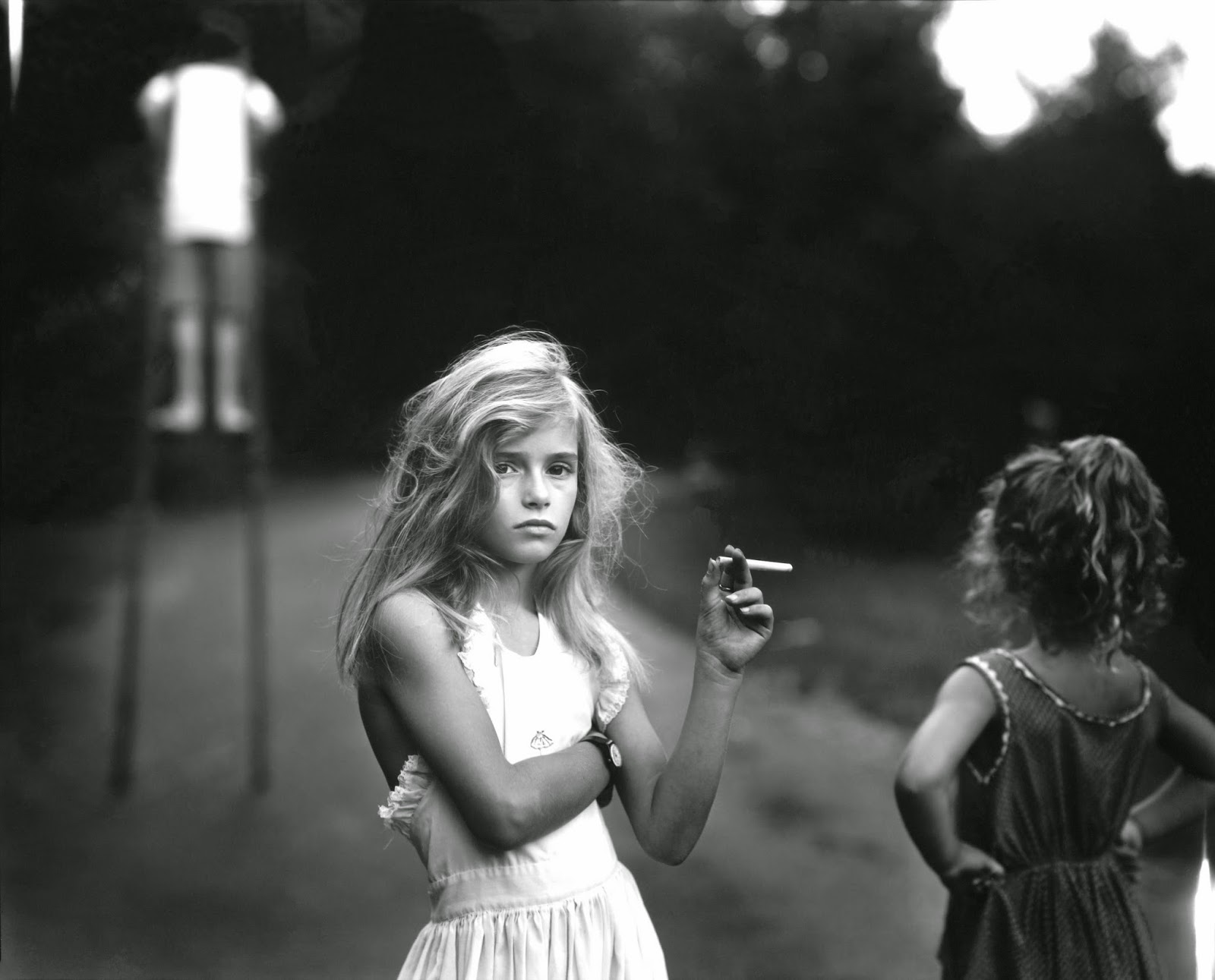
 This photograph by Sally Mann is from the collection Immediate Family and this charming image ironically named Candy Cigarette depicts one of Sally Mann's young children staring down the lens at her mother clutching a fake toy cigarette with the attitude of someone whose witnessed a war.


 Sally Mann is incredibly well known for her landscape photography, in this photograph Sally ensures that the first thing the viewers look at is the tree on the right hand side of the image. Mann uses depth in order to draw the viewers into the photograph and along the back straight.


This photograph is from Sally Mann's collection called What Remains. As a collection What Remains is a collection which shows the epitome of evidence, the collection is full of decaying bodies, death and the last strands of life reaching out of the images. This image here shows just how close you can be before the end comes, the hands are so very nearly touching but no quite.


How I was Influenced...
Sally Mann is one of my influences because I enjoy the way she prints in black and white, I love the severity and edge that the bright white tones give the photographs and the depth within the darkness of the corners of the photographs. The main theme of Sally Mann's photography could be known as evidence however every collection is a different type of evidence, Immediate Family is evidence of family, What Remains is evidence of life and death, At Twelve: Portraits of Young Women is evidence of ageing and transition. Most of Sally Mann's photographs are full of raw emotion especially when she chose to photograph her own husbands fight with late-onset muscular dystrophy for her collection Proud Flesh which she took over a six year interval. The result of the rare reversal of photographic roles are candid, extraordinarily gut wrenching and touchingly frank portraits of a man at his most vulnerable moment.
Since studying Sally Mann I have tried to use this sharp black and white tone in my work and really think it adds brightness to the photograph and helps other parts stand out while keeping others in the shadows.