Friday, 10 April 2015

Tom Kershaw

Tom Kershaw is an award winning digital design director and photographer who, for over a decade has lead projects for huge named brands such as Nikon, Adidas, Panasonic, Microsoft, Stella McCartney, Nokia, Virgin and others. Born in London, Tom now takes up residency in Boston in the United States where he combines his love of technology and paying an obsessive amount of detail to the finer things into a company called IDEO. Prior to working at IDEO he worked at various other companies in the same trade. Tom has been nationally recognised and awarded by The Webbys, Red Dot, One Show, The Hatch Awards and others. The talented designer and photographer that he is he has been recognised by many elite photography and design publications. 
I chose to study Tom Kershaw when I stumbled across his collection of Black Lips, the collection stayed true to his name and the mandatory section for this collection was that the models pose in black lipstick, this theme held throughout the collection and was able to tell a story about each of the models. 


This photograph is part of the Black Lips collection, I love this portrait because Tom Kershaw uses harsh white base make-up and hair colourant in order to show the stark nature of the Black Lips against the background, all other colours on the portrait tie in with either black or white making this image severely extreme.


This photograph from the collection of Black Lips by Tom Kershaw is yet another element of this collection, the previous photograph shows a strong independent, dominating woman who isnt worried or scared and can fend for herself whereas this portrait shows a playful young minx who looks like she could cause a lot of trouble. This is an example of how Tom Kershaw uses one mandatory component (black lips) in his photography in order to explain multiple emotions or feelings.


This photograph from the collection of Black Lips by Tom Kershaw is much less posed than the first image I chose, the first image came across as strong and powerful and dominant, as if the girl in the photograph held full control however here the girl looks dazed, confused and tormented.


This photograph by Tom Kershaw is called "In Magenta" and he uses a colour overlay to paint his model in pink, by doing this he emphasizes the severity in the different amounts of tones there is within this one image.


How I was Influenced...
Tom Kershaw was one of my influences for this topic due to the fact his work maintains my theme of beauty and identity. In his work he uses colour, editing and makeup to change the identities of the people he shoots. Especially within the Black Lips collection, Tom Kershaw used the idea of makeup to transform the aesthetic nature of the women and men in the shoot. Despite the fact each photograph is more or less of a different woman it shows how even if one feature of makeup is kept e.g. Black Lips the rest of the photograph can change however this is still the focal point due to the pressure of society in this day and age. I enjoy focusing on Tom Kershaws photography due to the way the dark nature of the Black Lips looks like it has infected the women and transferred the attitude from the black gothic colouring into the womens brains and filled them with sass. 
Since studying Tom Kershaw I have been inspired to experiment with severe colour changes to my photographs and maintaining specific makeup looks, Tom Kershaw is one of the influences that I have for my final exam.

Sally Mann

Sally Mann was born in Lexington, Virginia in the 1950's and is one of Americas most stand out photographers in recent years. Ms Mann's work has been featured in many major international institutions has been the recipient of many grants and awards. Sally Mann has a huge portfolio including: Second Sight (1983), At Twelve (1988), Immediate Family (1992), Still Time (1994), What Remains (2003), Deep South (2005), Proud Flesh (2009) and The Flesh and the Spirit (2010). Mann has photographed in the American South since the 70's focusing on portraiture, architecture, landscape and still life however she is best known for her landscape work or her intimate portraiture collections which paint pictures of her life involving her three children and husband. Despite the controversial nature of Sally's work she has always been seen as influencial. Sally Mann quite often chose topics close to her to base her portraiture collections around, for example her second publication At Twelve: Portraits of Young Women and Immediate Family were inspired by her three young children, the series Immediate Family especially is touching as it hits all the aspects of their daily lives such as playing, sleeping and eating however also touches on larger themes such as death and cultural perceptions of sexuality.
I chose to study Sally Mann as I love the raw nature of her photographs, she lets the viewers into her life with the collections that could include incredibly sensitive areas of her life such as when  her husband Larry was suffering late-onset Muscular Dystrophy. I love the way Sally Mann chooses to photograph un-posed subjects creating raw candid shots which are full of life.


 This is a photograph by Sally Mann taken from the collection At Twelve: Portraits of Young Women which shows the epitome of beautiful natural youth. Sally Mann's photographs from this collection are examples of evidence of the passage of time.


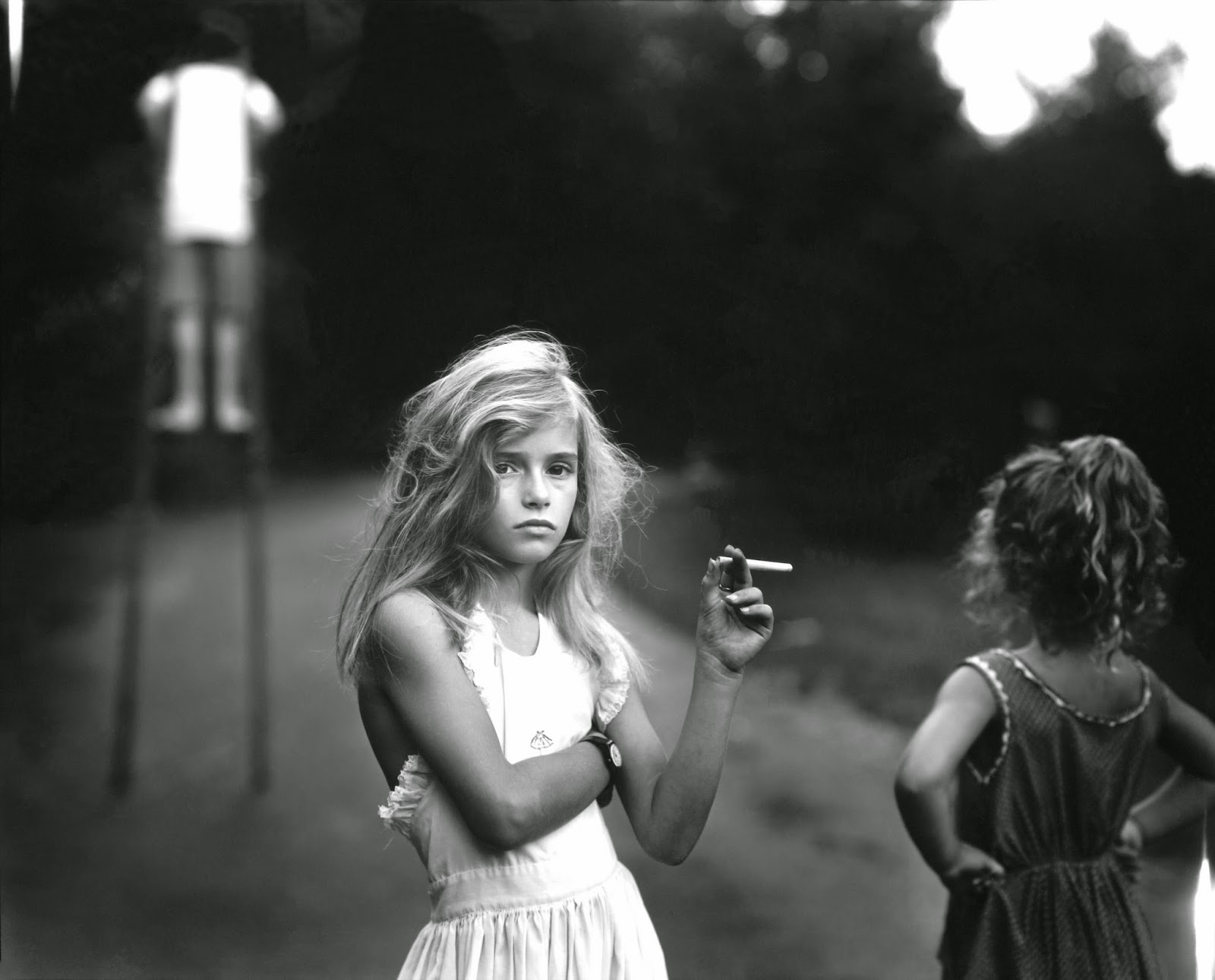
 This photograph by Sally Mann is from the collection Immediate Family and this charming image ironically named Candy Cigarette depicts one of Sally Mann's young children staring down the lens at her mother clutching a fake toy cigarette with the attitude of someone whose witnessed a war.


 Sally Mann is incredibly well known for her landscape photography, in this photograph Sally ensures that the first thing the viewers look at is the tree on the right hand side of the image. Mann uses depth in order to draw the viewers into the photograph and along the back straight.


This photograph is from Sally Mann's collection called What Remains. As a collection What Remains is a collection which shows the epitome of evidence, the collection is full of decaying bodies, death and the last strands of life reaching out of the images. This image here shows just how close you can be before the end comes, the hands are so very nearly touching but no quite.


How I was Influenced...
Sally Mann is one of my influences because I enjoy the way she prints in black and white, I love the severity and edge that the bright white tones give the photographs and the depth within the darkness of the corners of the photographs. The main theme of Sally Mann's photography could be known as evidence however every collection is a different type of evidence, Immediate Family is evidence of family, What Remains is evidence of life and death, At Twelve: Portraits of Young Women is evidence of ageing and transition. Most of Sally Mann's photographs are full of raw emotion especially when she chose to photograph her own husbands fight with late-onset muscular dystrophy for her collection Proud Flesh which she took over a six year interval. The result of the rare reversal of photographic roles are candid, extraordinarily gut wrenching and touchingly frank portraits of a man at his most vulnerable moment.
Since studying Sally Mann I have tried to use this sharp black and white tone in my work and really think it adds brightness to the photograph and helps other parts stand out while keeping others in the shadows.

Cara Phillips

Cara Phillips is a Brooklyn based photographer who was born and raised in Detroit, Michigan. Ms Phillips started her career in the beauty industry as a child model for Ford Models. Her first career into adulthood concerning beauty was creating make-over's for every day women in department stores such as Macy's. However between 2004 and 2007 Cara Phillips returned to education and was accepted to a place at Sarah Lawrence College studying photography. Since her graduation she has become an independent photographer and has focused on her own work whilst collaborating on various projects. Ms Phillips is a co-founder of the online exhibition site Women In Photography and belongs to the international photography organization Piece Of Cake. Over the last eight years Cara Phillips has received many awards and has taken part in several private collections. 
I chose to study Cara Phillips as I adore her collection Ultraviolet Beauties where she used an ultraviolet light to show age spots and skin damage that would otherwise be unnoticed by the guise of a healthy tan. I find Ms Phillips collection inspiring due to its originality, the way the models are so naturally posed but un-posed is sobering to look at. Here I have chosen four photographs from the collection to annotate and discuss...


I chose this photograph from the collection Ultraviolet Beauties because I love the way the illuminating photograph shows the hidden imperfections strewn across the subject's face. I love the way the photo is in black and white which emphasizes the damaged areas of the subjects skin but also adds tone to the photograph.

(From the collection: Ultraviolet Beauties)


I chose this photograph (Again from the Ultraviolet Beauties collection) because I love the way the photograph is toned and the way the darkness of the subjects roots contrast with the subjects highlights then the shiny paleness against the sun damaged freckly bridge of her nose.

(From the collection: Ultraviolet Beauties)


I chose this photograph because it almost looks like the colours have been inverted where this man clearly protects his eyes from sun damage with sunglasses. The darker and lighter variations of sun damage splashed around the subjects face show tone.

(From the collection: Ultraviolet Beauties)


This is my favourite one of Cara Phillips photographs, the natural imperfections that come in the form of freckles under the UV  lighting add individual personality to each one of the photographs in this collection. Every person is effected differently under UV lighting  due to the fact that all our imperfections are not the same.

(From the collection: Ultraviolet Beauties)


How I was Influenced...

Cara Phillips was one of the inspirations for my interest in beauty and routine however in my work I have looked at the perfection side of beauty, what we as people build ourselves up to be and how we change our identity. Cara Phillips looks at the natural imperfections caused by the natural elements, she uses UV lighting although not the same kind that the medical profession use due to the fact that it would cost $20,000. In fact, due to the extreme cost necessary Cara Phillips shot her collection by offering free portraits to strangers on the streets; only requirement being that they sit for the portrait underneath an ultraviolet light. Cara Phillips focus on the imperfections in human beauty fascinated me and gave me the idea to create black and white portraits, the simplicity of these portraits is one of my favourite things, I love the way any one photo of a person can have ten different meanings. Cara Phillips has inspired me with an idea to create imperfections using the thing that usually helps us create our new perfection, identity etc. for example makeup. 
Since studying Cara Phillips I have been inspired to take photographs which are more simple, more plain types of portraits rather than intricate planned multiple imageries and sequences. Studying Phillips encouraged me to observe the imperfections in photographs rather than the perfections.

Friday, 3 April 2015

Connecting Essay 3

Internet Photograph:

My Own Photograph:

The photograph that I chose from the internet depicts a hand holding a cigarette, this photograph is in black and white which brings out the shadows within the photograph and shows which way the sunlight is shining due to the extreme light and dark areas of the photograph. This photograph is taken from above and is fitted equally in the frame at the side with an equal amount of space at the top and bottom as if it were a portrait, this shows that the photographer wanted to draw the attention of the viewer to the hand.

The photograph of my own I have chosen tells the story of a smoker holding her cigarette, I took this photograph from the front due to the fact I thought it gave a more realistic view of the cigarette, I didnt want to take a photograph that glorifies smoking as much however I did want to take a photo that could possibly be used to show its negative sides, due to the fact there is many of them. I chose to keep this photograph in colour in order to show the contrast in colours between the natural yellow of the sunlight and the artificial yellow of the cigarette end.

These photos are similar in theme, they are both photographs of hands holding cigarettes however the first image suggests a glorification of smoking due to the heavy editing that has been done and the photographer clearly set up the photo in this way in order to lead the eye of the viewer up the hand then to the cigarette, however in my photograph I worked towards an aim of de-glamorising the cigarette.

Thursday, 2 April 2015

Connecting Essay 2

Internet Photograph

My Own Photograph

The photograph I chose from the internet depicts a fading transition from a pair of human eyes to a pair of animal eyes, I like they layout of this photograph due to the fact it helps the photo to fade in a nice subtle way, in the top and bottom photos the images are clear however the two middle ones are merged images that look like a mix of animal and human eyes. I like the way the photos have been perfectly positioned in order to keep a strong line down the middle and keep the symmetry of the multiple imagery-esque photo.

In my own photograph that I chose my idea was to focus on how every persons eyes differentiate for example the shapes; are they round or oval shaped? the colour; are they blue or green? lashes; long or short? size: big or small? hooded? makeup? the ways in which peoples eyes are different could be further listed too. I also chose this theme due to the way it links with evidence, for example on many of the girls in this photograph there is evidence of makeup. I wanted to explore the idea that many people in society share that we should change our identities to fit in. Make-up and the beauty industry are a prime example of this.

I think these photographs are similar in both theme and layout. Both of these photographs share the theme of changing your identity due to the fact that the first image shows a transition from one thing to another whereas the second image is the example of how various different people have altered their appearance. Secondly, the layout of both these photographs are the same, they both use a vertical drop down effect where the photographs are almost listed. Another similarity is how both the internet photograph and my own photograph share the same amount of distance between the lens and the subject.

Wednesday, 1 April 2015

Connecting Essay 1

Internet Photograph:


My Own Photograph:


The photograph I have chosen from the internet is a multiple imagery made up of nine images which focuses on the mouth and lips in different positions. The photographs are taken very close up to the subjects face. The editor of these photographs has been very careful to keep the spacing even between the images and keep the photographs the same distance from the camera lens/zoomed in a fixed amount for every photograph.

The photograph I took on one of my own shoots is a multiple imagery made up of twelve images which focuses on the mouth and lips in different positions. I chose to use a macro lens for this shoot in order to get incredibly clear photographs of my focus point. When editing I took my time and care in order to make sure there was even spacing between the photographs and a pattern within the photographs I picked.

However, despite the fact that these two photographs are not dissimilar in theme they are different in the way that the internet photograph focuses on multiple people's mouths in the same position but my own photograph focuses on the same mouth in multiple different positions. A similarity of these two images are that they are both multiple imageries however one of these images has twelve images and one of them has nine. What I like about these multiple image photos is the way they focus on the specific areas of the face.